
Palmyra Arrest Booking Path
The borough counted 7,830 people at the 2020 Census. Police service comes from the Western Lebanon County Regional Police Department, known as WLCRPD. Palmyra no longer fields a standalone department. That regional setup shapes where any search begins. When a case needs a criminal complaint, the arrested person goes to Lebanon County Central Booking. It is a round-the-clock county facility where defendants are fingerprinted, photographed, and video-arraigned ahead of the preliminary hearing.
Booking does not lock anyone into a cell at the county prison. A magisterial district judge sets monetary or non-monetary bail at the preliminary arraignment. Someone held or committed locally may land at Lebanon County Correctional Facility. The LCCF page names the facility. No public searchable roster or photo viewer exists there.
Where Palmyra Busted Mugshots Appear
The WLCRPD agency page is the official starting point for Palmyra. Its rolling arrests tab carries agency posts. Those posts list arrest dates, charges, narratives, and a photo or other media when the department supplies one. Nothing is promised, though. There is no fixed same-day publication window. There is no stated retention period, and no rule that every arrest comes with an image. For coverage across more participating agencies, county CRIMEWATCH is the next official stop.
| Channel | Official status | Record or custody meaning |
|---|---|---|
| WLCRPD Arrests feed | Official participating-agency source | Rolling agency arrest posts; an image appears only if attached by the agency. |
| WLCRPD April 2026 blotter | Official agency publication | Multi-day citations and incidents, not a present-custody roster. |
| County CRIMEWATCH Arrests | Official countywide source | Recent participating-agency posts, which can include released people. |
| LCCF and PA SAVIN | Official custody channels | Facility context and custody-event alerts; no public LCCF roster was verified. |
| UJS and PA DOC | Official court or state source | Later docket outcome, or state-sentence and parole status when applicable. |
RecentlyBooked publishes countywide and unofficially. A Palmyra entry can show up there, but a Palmyra-only filter is not available. Mugshots.com is an older county archive, not a dependable source for recent activity. Neither site can confirm who is in custody right now. Neither replaces the regional feed, the county feed, or the court record.
Each official channel has its own narrow job. The regional feed shows what an agency published. A monthly blotter reaches further back but is not a jail list. Central Booking explains how a defendant is processed. LCCF describes facility custody without a results screen. UJS picks the case up once it reaches court. Keeping these lanes straight prevents one kind of record from being mistaken for another.
Check Busted Palmyra Records
Search with the agency structure in your head. A Palmyra address does not mean a separate city jail feed exists. A citation entry is not the same as a custodial booking. Match the person, the date, the municipality, and the incident details across official records before drawing conclusions from a brief post. For the wider picture, the Lebanon County arrest and booking reference covers the countywide paths in more depth.
- Open WLCRPD's arrests tab and review the published agency post for the name, date, narrative, and alleged charge.
- Check the county CRIMEWATCH arrests feed if the regional feed has no visible entry or another agency may have posted it.
- Use PA SAVIN/VINE for custody-event notifications when the concern is release, transfer, or similar status. It is not a photo search.
- Search UJS Case Search by participant name and Lebanon County to locate a public docket and later court action.
- Use PA DOC only for a state-sentenced person or state parolee, not for ordinary county intake.
Never read a post date as a release date. Someone cited in a regional blotter may never enter LCCF at all. A person named in a rolling arrest post may already be out. A quiet feed proves nothing either way, since police events happen without a matching feed item.
Palmyra WLCRPD Records
Need a police record on a Palmyra matter? WLCRPD's Right-to-Know process is the route. Give the person's name, the date, and the location. Add the incident or arrest number if you have it, plus the exact record you want. The agency's report-verification form confirms whether a complaint was filed. It is not how you request a booking photo. No published WLCRPD booking-photo fee exists.
Western Lebanon County Regional Police Department
325 S. Railroad Street
Palmyra, PA 17078
Phone: 717-838-8189
Fax: 717-838-7002
Agency Open Records Officer: Chief Andrew Winters
Written requests can go through the agency webform, by mail, or hand delivered. RTK hours: Monday through Friday, 7:00 a.m. to 3:00 p.m.
Criminal-investigative records can get separate appeal treatment. The response itself will state which route applies. A record may be withheld, redacted, or referred under the law. And don't assume the regional agency, Central Booking, and LCCF hold identical copies. The custodian and the record type matter most.
WLCRPD also splits its Act 22 route from the general RTK path. That one covers audio and video. It works from event details and carries its own $200-per-granted-recording fee plus a 30-day framework. The figure applies only to recordings, not booking photos. Leave it out of an ordinary police-record request. If a response points to a different custodian, follow that agency's process rather than guessing who holds a photograph.
Palmyra Busted Blotter Window
Want multi-day Palmyra arrest context? The Western Lebanon County Regional Police Department publishes a consolidated blotter. One example covers April 1 through April 30, 2026, pairing incident details with citation-style entries. That format makes it a handy local reference. It is not a live jail roster, though. Nor does one published blotter promise a monthly URL, a fixed schedule, or an entry for every booking.
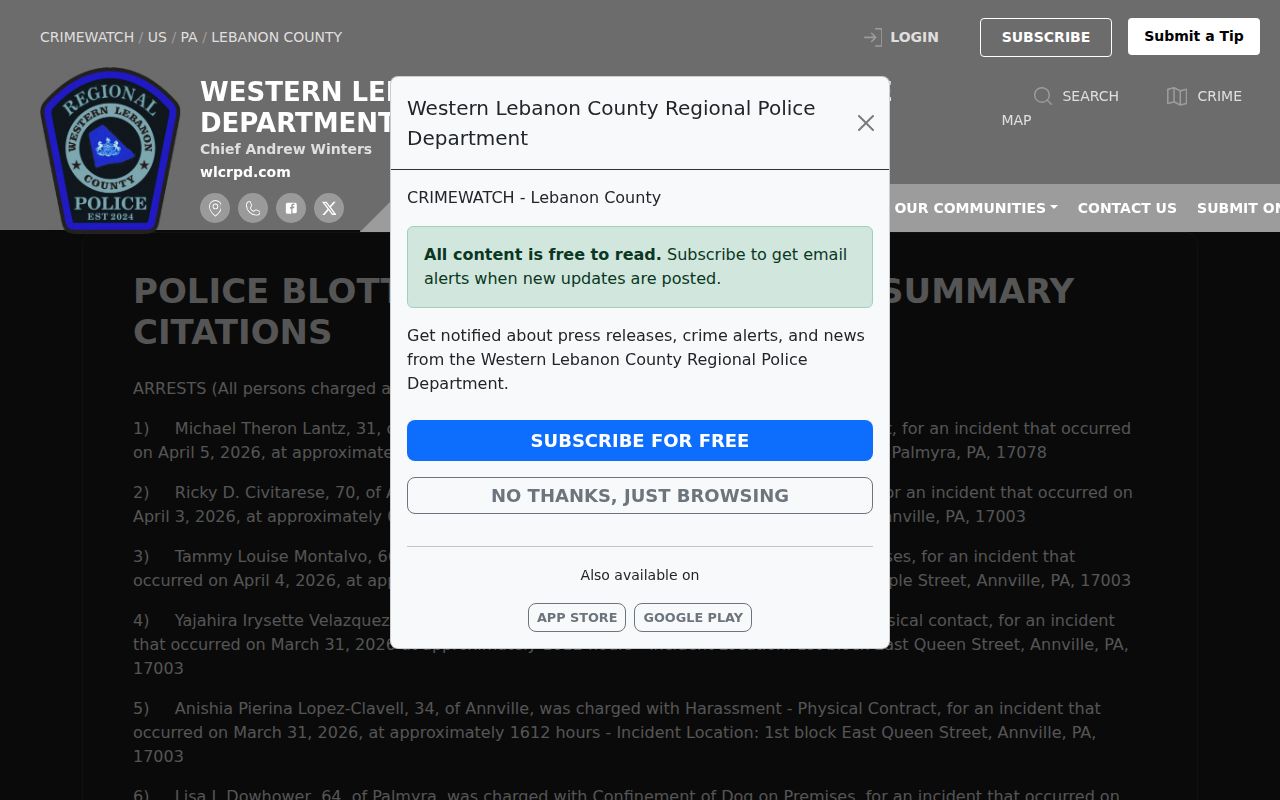
Blotter entries can name a charged person. They often list the municipality, the offense, the date and time, and where the incident happened. Those fields differ from what a jail roster tracks, and both differ from court records. Treat the blotter as one layer, not the whole picture.
Palmyra Regional Arrest Coverage
The regional-force setup matters most here. An older reference may still name a local Palmyra police label. Current searches should follow WLCRPD. The department also covers Annville and contracted areas, so check the municipality named in any post. Remember that the shared feed is an agency channel, not a promise that every county arrest tied to a Palmyra address or resident appears there.
When criminal intake is required, County Central Booking handles the next step. Defendants get photographed and fingerprinted during processing. The office does not publish photos on any promised schedule. A booking picture can sit as an internal record without ever appearing on a regional post. When an agency does supply an image, it stays with the original source post.
Palmyra Busted News Sources
Start with official WLCRPD and county CRIMEWATCH material. Local news adds breadth from there. LebTown publishes Lebanon County blotter reporting from time to time and sometimes includes Palmyra items, though its stories are selective rather than a full booking feed. WGAL has covered selected Palmyra public-safety stories, but its event-driven reporting is not a mugshot index. Lebanon Daily News is another lead worth a look, even without a confirmed stable county blotter section.
News coverage works best as a pointer. Use it to find the source agency. Then go back to official posts and the UJS docket. The wider Lebanon County arrest-news resource breaks down how a news account, an agency report, and a court result differ. Scene photos or video in a story are not the same as a booking photograph.
Palmyra Arrest Court Outcome
UJS Case Search handles court follow-up. Enter a name and Lebanon County. From there, narrow things by docket type, date, complaint number, incident number, OTN, or agency detail. Prefixes tell you where a case sits. MJ points to a magisterial district judge matter. CP means the Court of Common Pleas. If nothing turns up, the cause may be a filing delay or a public-access limit rather than a final answer.
After arrest, the local sequence can run through preliminary arraignment, bail, a preliminary hearing, Common Pleas filings, plea or trial, sentencing, and appeal. Charges can be dismissed at the preliminary hearing when the required showing falls short. The official docket supplies that outcome context, not a feed headline.
Public court results have limits too. UJS does not issue statewide criminal-history certificates. Searches can miss juvenile, expunged, sealed, limited-access, or destroyed matters. Dockets may lag after a new arrest or shift as a case develops. When comparing a feed entry to a docket, keep the original post date and agency attribution intact.